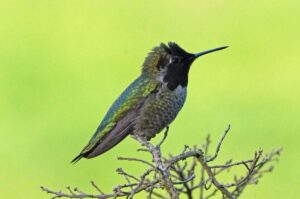
It started with a sound — a sharp, electric zeeeep! Then I saw him: a male Anna’s hummingbird, not much larger than my thumb, had just landed on a thin telephone wire above our Berkeley porch. His gorget blazed crimson-magenta in the morning sun, shifting to deep rose as he angled his head. After a moment’s stillness, he was gone again from the wire: a green streak climbing straight up into the pale sky above the yard until he was almost out of sight.
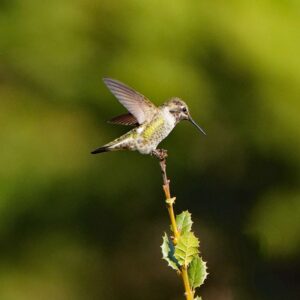
I found the female a second later, perched in our apricot tree. She sat perfectly still on a low branch, watching. The male was already falling.
He came down at speed that seemed impossible for a living thing — researchers at UC Berkeley have clocked the Anna’s courtship dive at over 50 miles per hour, attaining nearly 385 body lengths per second, faster length-for-length than any other known vertebrate. At the bottom of the arc, less than a foot from the female, he spread his tail feathers in a 60-millisecond flare: zip! That sharp crack is not a vocal sound. It is made entirely by the outer tail feathers vibrating like a reed in a clarinet at dive speed, a discovery made by students at UC Berkeley who filmed the display with high-speed cameras at the Albany Bulb. The male then swept up in a circular arc and reset at the top, ready to do it again.
On sunny days, males orient their dives so that the sun reflects directly off their iridescent crown and gorget — every detail of this high-speed drama is calculated to dazzle. But if the female was impressed, she didn’t show it. She looked on with a composure that suggested she had seen this all before. She tilted her head slightly. He dove again. Perhaps more effusive audience members, my husband and I both sat on the porch and raptly watched dive after dive.
Fourteen species of hummingbird have been recorded in the Bay Area, though most visits are brief or accidental. Three species are the main characters in our local story, and they divide their year here in different ways.
The Anna’s Hummingbird (Calypte anna) is our year-round resident. This is the only hummingbird that winters and breeds in the Bay Area without migrating. Before the 1930s, breeding populations of Anna’s extended only as far north as the San Francisco Bay area itself — the Bay Area was then their northern frontier. But, with the help of ornamental gardens expanding all through the Pacific Northwest, their range has expanded north in recent decades.
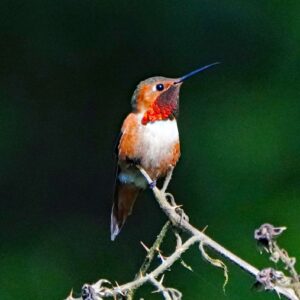
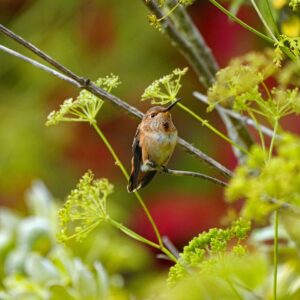
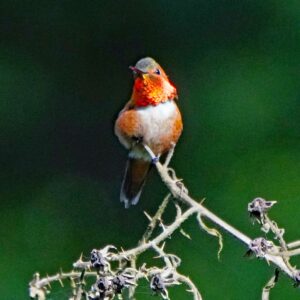
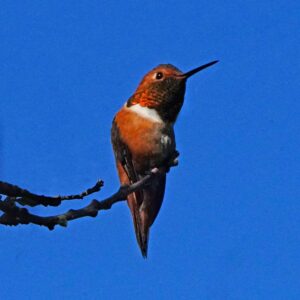
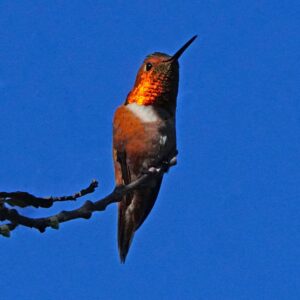
The Allen’s Hummingbird (Selasphorus sasin) is the other most common of the nesting hummingbirds we’re likely to find in northern California gardens, alongside the Anna’s. Males have copper-orange sides and a brilliant reddish-orange throat. Most of the population winters in Mexico and migrates back up the coast as early as January.
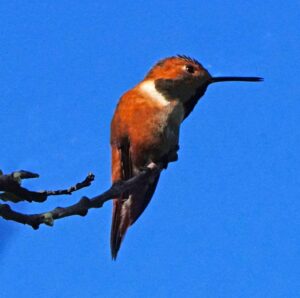
And the Rufous Hummingbird (Selasphorus rufus) is a vivid copper-orange migrant that passes through in spring. Rufous hummingbirds fly north up the Pacific Coast in spring and return via the Rocky Mountains in fall: a loop migration. They don’t nest here but they announce their passage loudly, chasing every other hummingbird from the feeder.
The Allen’s and Anna’s are the species most likely sharing your yard right now. They look similar at first glance — both small, green-backed, with iridescent throat patches — but the male Allen’s has that distinctive copper-orange wash on the flanks and rump that the Anna’s lacks entirely. Females of the two species are nearly identical in the field; even expert birders sometimes defer to banding data.
The most remarkable thing about Bay Area hummingbirds is the way they use the region across the calendar — a kind of relay, with different birds occupying the same flowering shrubs and garden feeders in different seasons.
Unlike the Bay Area’s other hummingbird species, which migrate down to Mexico when the weather gets colder, the Anna’s hummingbird can be found wintering and breeding as far north as Vancouver Island. Their cold tolerance allows them to stay a step ahead of other hummingbird species, which tend to breed a little bit later, and to time their fledging with chaparral, currant and gooseberry blooms.
The Allen’s, by contrast, are early and fast. They spend winter in Mexico and migrate as early as January up to the Pacific Coast in California and Oregon — a remarkable schedule that has them back on territory while winter still lingers. They nest along the coast and in well-wooded gardens, then most of the migratory population heads south again by late summer, leaving the Anna’s to hold the yard through autumn and winter.
The Rufous hummingbird is the spectacular through-traveler: one of the longest-migrating birds relative to body size on earth. Some individuals complete a round-trip of nearly 4,000 miles between Alaskan breeding grounds (where I used to encounter them as a wilderness guide) and Mexican wintering sites. They pass through the Bay Area in spring heading north, blazing and belligerent at feeders, and then again — usually inland along the Sierras — heading south in late summer. A rufous at your feeder in April is a bird on a journey; it won’t be here long.
The hummingbirds passing through our backyards this spring have different tales to tell. Anna’s hummingbirds are, against most trends, a genuine conservation success story. An analysis of North American Breeding Bird Survey data indicates that the Anna’s Hummingbird population has increased by 2% per year from 1966 to 2010. Since the 1970s, ornamental plants in residential areas along the Pacific coast and inland deserts provided expanded nectar and nesting sites, allowing the species to expand its breeding range to northern coastal regions without migrating.
The Allen’s hummingbird tells a different story. Allen’s hummingbird populations have crashed nearly 88% since 1970, earning this species a spot on the “Red Alert Tipping Point” list in the 2025 State of the Birds report. The culprits include coastal habitat fragmentation, pesticide loss of the insect base, and invasive plants crowding out native nectar sources. The Allen’s has one of the most restricted breeding ranges of any North American hummingbird — a narrow coastal strip — which makes it acutely vulnerable to what happens in that strip.
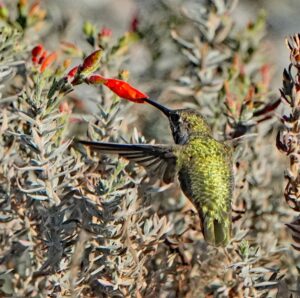
The practical upshot for Bay Area gardeners is clear: planting native flowering plants — California fuchsia, penstemon, monkeyflower, salvia, currant and gooseberry — provides a food base that aligns with seasonal migration, supports the insect populations hummingbirds need for protein, and costs the gardener almost nothing in maintenance once established.
As for the little hummingbirds that we watched from our front porch?
The Anna’s female almost certainly began nesting weeks before the dive display we witnessed. The nesting season for Anna’s hummingbird begins in December and lasts through August — which means that in the Bay Area, while the rest of the continent’s birds are still thinking about spring, the Anna’s is already weeks into the parenting cycle.
Right now, somewhere near our apricot tree, there is almost certainly a nest. And in that nest, there are probably chicks. At roughly 18 days old, chicks become alert, stretching their tiny wings, preening their new feathers — signs of a healthy and growing young bird preparing to fledge about 20 days after hatching.
Anna’s nests are compact cups of plant fibers and spider webs, lined with plant down and sometimes feathers, with the outside camouflaged with lichens — a construction so well-disguised that it can sit in plain view for weeks before you notice it. If you’ve ever been lucky enough to watch a hummingbird collect spider webs for her nest, she’s doing it for a good reason: spider silk is elastic. The nest actually expands as the chicks grow, accommodating nestlings that double and triple in size over the first two weeks. A single nest can stretch from walnut-sized to golf ball-sized by fledging time!
A nesting female Anna’s hummingbird will collect up to 2,000 insects in a single day to feed both herself and her growing chicks, which need a high-protein diet for proper development. Perhaps surprisingly, hummingbirds are not nectar specialists! They are protein-hungry hunters that supplement heavily with tiny midges, gnats, leafhoppers, and spiders, especially when feeding young. Nectar fuels the adult; insects build the chick.
This species typically raises two or more clutches per season. If the female from the apricot tree successfully fledges her current brood in the next few weeks, she will likely begin a second nest almost immediately — possibly in the same tree, possibly in the same nest, which she may rebuild and expand. The male, meanwhile, contributes nothing to any of this. He is somewhere in the garden, singing his scratchy metallic song from a favorite perch and defending his territory against rivals.
The fledglings, when they leave the nest, will be briefly dependent — fed by their mother for one or two weeks as they learn to catch insects on the wing and navigate flowers. Then they’ll disperse. By summer, Anna’s hummingbirds may wander into the Sierra foothills and later up into high mountain meadows, following the bloom as the season progresses through altitude. They will return to lower elevations as the year cools, and by December, the whole cycle begins again.
When I stood on the porch watching those dives, I was watching the beginning of something months in the making and months yet to come: a nest taking shape, a protein budget being calculated in tiny insect calories, two eggs the size of Tic Tacs, and eventually — if everything goes right — two more hummingbirds learning to fly in our front garden.
The male is probably still out there—and one might be in your yard, too! If you stand quietly long enough, you might hear his telltale zeeep!