
On a bright, brisk July morning, the sand dunes at North Beach in Point Reyes National Seashore look empty at first glance—just wind-etched hills of sand, blown beachgrass, and the steady roar of the Pacific. But if you know what to look for, as Ryan DiGaudio does, signs of life start to appear.
“There,” he says, pointing a series of faint, three-toed prints stitched into the sand like Morse code. “That’s our first clue.” We’ve come here with Ryan, a biologist with Point Blue Conservation Science, to search for nests of the Western Snowy Plover, a tiny shorebird that’s easy to miss but hard not to love once you find it.
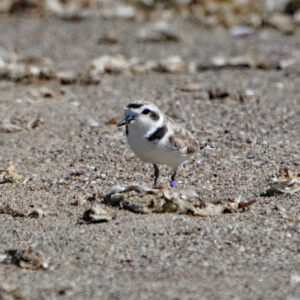
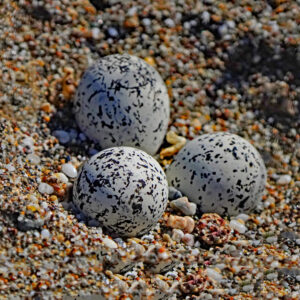
Snowy Plovers are sand-colored, round-bodied birds with dark eye patches and legs like toothpicks. Camouflage is their best defense—they nest right on the open beach, laying eggs in shallow scrapes in the sand. But that same vulnerability has pushed them to the brink. Listed as a threatened species under the Endangered Species Act since 1993, Snowy Plovers have struggled to hold on to their habitat in California. Development, off-leash dogs, beachgoers, and predators like ravens and gulls have made nesting a perilous gamble.
Point Reyes remains one of their last strongholds in the Bay Area, and much of that is thanks to the long-standing partnership between Point Blue and the National Park Service. Ryan’s team monitors the beaches daily during breeding season, mapping nest locations, banding chicks, and erecting protective enclosures around vulnerable nests. It’s meticulous work, requiring patience, sharp eyes, and deep familiarity with a landscape that’s constantly shifting under the wind.
We follow Ryan across the dunes as he scans the ground with a spotting scope. Ryan’s puffy gray jacket and tan canvas pants make him look like a creature of the sands, too—he blends in almost as well as the birds he seeks. The morning light glints off the ocean, and a raven wheels high above, its shadow skimming the sand. Ryan watches it carefully. “Ravens are smart,” he says. “They learn where the nests are. Once they’ve found one, they keep coming back.”

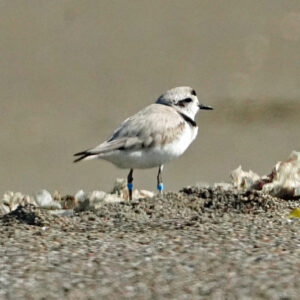
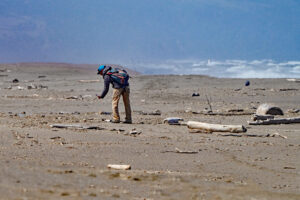
He kneels to inspect a shallow depression in the sand—a possible scrape—but finds no eggs. Not yet. Then, Ryan spots a soft flutter in the distance. He lifts the scope. “That’s Aqua-Silver-Yellow-Yellow,” he says with a grin. “The King of North Beach.”
The bird’s name comes from the colored bands on the plover’s legs, used to identify individuals and track their movements over time. Aqua-Silver-Yellow-Yellow has returned to North Beach year after year, a testament to both his survival skills and the conservation work that’s made this beach a safer place to raise chicks.
The King of North Beach has fledged at least 1 chick every year (sometimes 3 or more, Ryan tells us!) and is currently Point Reyes’s oldest plover at about 10 years old (the average plover lifespan is less than 5 years, although some can live to be nearly 20). This particular little bird is very faithful to his territory—he’s been successfully defending and raising broods in this single 200-yard stretch of North Beach throughout his decade-long “reign.” Ryan speaks of him like an old friend, with unmasked affection.
On a beach that had seemed empty a moment before, Aqua-Silver-Yellow-Yellow’s appearance—scuttling low and swift across the sand—makes us grin. With the help of careful conservation work and an educated public, these little birds are tougher than they look.
The day ends with no new nests discovered, but Ryan doesn’t seem discouraged. Every hour spent watching and tracking is part of a larger story—a decades-long effort to keep a vulnerable species from slipping through the cracks.
Learn more about Point Blue’s work with Western Snowy Plovers here. Sign up to be a Point Reyes National Seashore plover docent for next summer!